

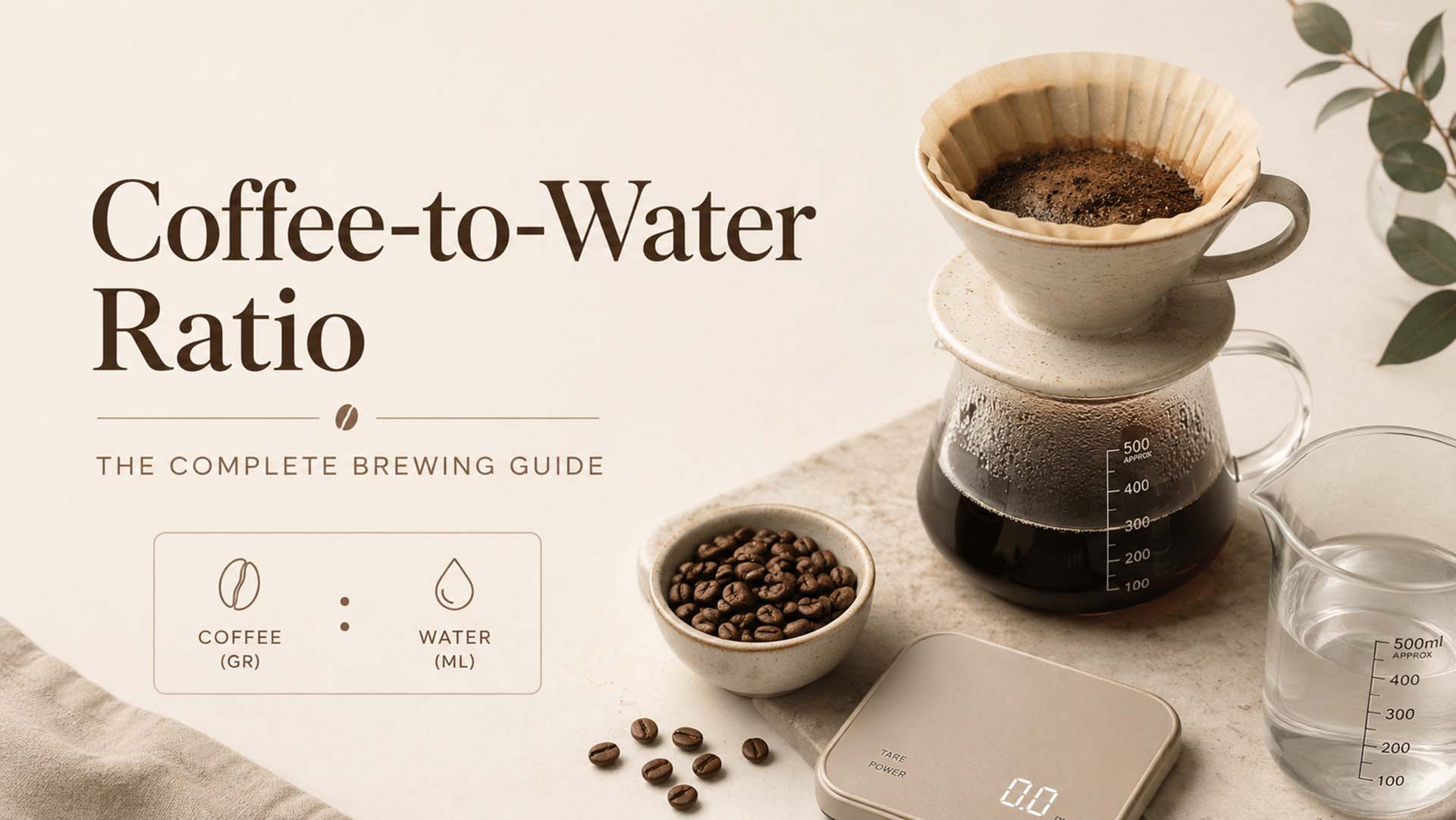
Coffee-to-Water Ratio: The Complete Brewing Guide
There are plenty of ways to make coffee complicated. Ratio doesn’t need to be one of them.
At Alpen Sierra, we’ve always believed that a tasty cup should be within reach whether you’re
brewing with a Chemex and gram scale, loading an automatic drip brewer before the household
wakes up, or making coffee outside somewhere around Tahoe.
One of the easiest ways to make that cup better—and make it better again tomorrow—is to pay
attention to how much coffee you’re using in relation to water.
That’s your coffee-to-water ratio.
Get reasonably close, use good water and properly ground coffee, and you’ve already taken care
of three of the biggest variables in brewing.
What Does Coffee-to-Water Ratio Mean?
A brewing ratio describes the amount of coffee used compared with the amount of water.
You’ll usually see it written like this:
1:16
That means one part coffee to 16 parts water.
So if you’re starting with 20 grams of coffee:
20 grams coffee × 16 = 320 grams water
Conveniently, one gram of water is approximately one milliliter, which makes a kitchen scale
particularly useful. Put your brewer on the scale, zero it, and you can measure both ingredients
without dirtying another measuring cup.
Simple.
More important, repeatable.
If a cup tastes especially good, you know what you did.
Alpen Sierra’s Starting Point: 1:17
There isn’t one sacred coffee ratio that works for every bean, roast, brewer, and palate.
For our own Chemex brewing method, we use the specialty coffee standard of
approximately 1 gram of coffee to 17 grams of water. Our house Chemex recipe
uses 50 grams of coffee with 850 grams of water.
That 1:17 ratio produces the kind of clean, sweet, smooth cup we look for from a Chemex.
For everyday home brewing, however, there’s a useful range rather than one absolute number:
- 1:15 — fuller and more concentrated
- 1:16 — balanced and versatile
- 1:17 — slightly lighter, with plenty of clarity
If you’re starting from scratch, 1:16 or 1:17 will put you in very good territory.
From there, taste the coffee before reaching for another rule.
You can see the exact Chemex technique we use, along with our auto-drip and French press
recommendations, in Alpen Sierra’s
Brewing Methods guide.
A Quick Coffee-to-Water Ratio Chart
Here’s an easy reference for a 1:16 ratio:
| Coffee | Water |
|---|---|
| 15 g | 240 g / about 8 oz |
| 20 g | 320 g / about 11 oz |
| 25 g | 400 g / about 14 oz |
| 30 g | 480 g / about 16 oz |
| 40 g | 640 g / about 22 oz |
| 60 g | 960 g / about 34 oz |
At 1:17, simply add a little more water.
For example:
20 grams coffee + 340 grams water
or
50 grams coffee + 850 grams water, which is our Chemex standard.
The difference between 1:16 and 1:17 isn’t enormous. That’s the point. Brewing adjustments don’t
need to be dramatic to change what you taste.
Coffee-to-Water Ratio for Pour-Over
Pour-over is where weighing coffee and water really starts to make sense.
The method gives you direct control over the water as it moves through the coffee bed, so a
consistent dose helps you learn what changes in grind, temperature, and pouring technique are
actually doing.
For a Chemex, Alpen Sierra starts at:
1:17
Our standard batch:
50 grams coffee + 850 grams water
We use water around 195–202°F, begin with a bloom, then continue with controlled
pulse pours.
For a smaller pour-over at home, you could begin with:
20 grams coffee + 340 grams water
If you’d like a slightly richer cup, move toward 1:16 without changing everything else at the
same time.
That’s an important habit. Change one variable, taste the result, then decide where to go next.
Coffee rewards curiosity much more than it rewards frantic adjustment.
Coffee-to-Water Ratio for Automatic Drip
Automatic drip is probably how more people make their daily coffee than any other method, and
there’s nothing wrong with that.
Good equipment, fresh coffee, filtered water, and a sensible ratio can produce an excellent cup
with very little ceremony.
Our
Brewing Methods guide
offers an easy volume-based standard when a scale isn’t part of the morning routine:
One standard coffee measure—about 2 level tablespoons or 10 grams of coffee—for each 6 ounces
of water.
If you’re weighing instead, somewhere around 1:16 to 1:17 is an excellent place
to begin.
One thing we pay particular attention to with automatic brewers is water temperature. A brewer
capable of maintaining roughly 195–202°F gives the coffee a much better chance
of extracting properly.
A precise ratio won’t fix a brewer that barely gets the water hot.
Coffee-to-Water Ratio for French Press
French press is an immersion method. Instead of water passing quickly through a coffee bed, the
grounds and water spend the brew time together.
That produces the heavier body and texture many people love about the method.
Start around:
1:15 to 1:16
For example:
30 grams coffee + 450–480 grams water
French press also calls for a relatively coarse grind.
If your cup is overly muddy, bitter, or dry, don’t immediately assume you used too much coffee.
The grind may simply be too fine, or the coffee may have steeped too long.
Likewise, a thin or sharply sour cup isn’t always asking for a bigger dose.
Ratio and extraction are related, but they’re not the same thing.
That distinction is worth learning.
Coffee-to-Water Ratio for AeroPress
The AeroPress is one of those brewers that seems to invite experimentation.
There are competition recipes, inverted recipes, concentrated recipes, long recipes, short
recipes—and plenty of perfectly good cups made without any of them.
For a conventional cup, a useful starting point is:
15–18 grams coffee + about 240 grams water
But the AeroPress can also make a much more concentrated brew. We explore that approach in
How to Use an AeroPress to Brew an Espresso
.
This is one brewer where we’d encourage you not to get too attached to a single ratio.
Try something.
Taste it.
Make the next one a little different.
Coffee-to-Water Ratio for Cold Brew
Cold brew is intentionally different.
Because extraction takes place slowly with cool water rather than quickly with hot water, cold
brew recipes often use considerably more coffee relative to water.
For something close to ready-to-drink strength, you might begin around:
1:8
For a concentrate:
1:4 to 1:5
So 100 grams of coffee might be paired with:
800 grams water for a ready-to-drink brew
or
400–500 grams water for concentrate
A concentrate is meant to be diluted afterward with water, milk, or ice.
There is plenty of room for preference here, especially as steep time and grind change. Our
Cold Brew guide
takes a closer look at the method itself.
And Then There’s Espresso
Espresso plays by different rules.
Instead of describing how much water goes into a brewer, espresso ratios generally compare the
dry coffee dose with the weight of the finished beverage.
A common starting point is:
1:2
For example:
18 grams of ground coffee → approximately 36 grams of espresso
That’s a very different concentration from drip or pour-over coffee, and small adjustments matter.
A couple of grams in finished yield can be noticeable.
Which is why espresso people tend to keep scales close by.
Do You Really Need a Scale?
No.
People made good coffee long before affordable digital scales lived on every kitchen counter.
But a scale makes consistency much easier.
A tablespoon measures volume. A gram measures mass.
Coffee beans change in density as they’re roasted. Different grind sizes settle into a scoop
differently. One generous tablespoon on Monday may not resemble Thursday’s.
Twenty grams, on the other hand, is twenty grams.
If you’re interested in improving home coffee without buying another elaborate brewer, a simple
digital scale is one of the most useful pieces of equipment you can add.
That and a quality burr grinder.
The Ratio Is Only Part of the Cup
Here’s where coffee gets interesting.
You can use exactly the right amount of coffee and water and still brew something disappointing.
Why?
Because water quality, grind size, temperature, freshness, and brewing time all influence
extraction.
At Alpen Sierra, we consider water especially important because brewed coffee is overwhelmingly
water. We recommend cold, clean, filtered water without obvious chlorine or other off-flavors.
Then there’s grind.
A finer grind exposes more surface area and generally increases extraction. A coarser grind does
the opposite. The right setting depends on how you’re brewing.
We’ve gone deeper into both subjects in
Why Grind Size and Water Quality Can Make a Big Difference
.
If you’ve nailed the ratio but the cup still isn’t right, that’s where we’d look next.
Strong Coffee and Over-Extracted Coffee Are Not the Same Thing
This one causes a lot of confusion.
Strength is about concentration.
Extraction is about what the water pulled from the coffee.
You can make a strong, beautifully extracted cup.
You can make a strong, bitter one.
You can also make weak coffee that is over-extracted and unpleasant.
If coffee tastes dry, harsh, hollow, sharply sour, or excessively bitter, changing the dose may
help—but it may not be the real problem.
Ask a few questions first:
- How fine is the grind?
- How hot is the water?
- How long is the brew taking?
- Is the coffee fresh?
- What does the water taste like on its own?
Coffee is usually more willing to tell you what’s wrong than we give it credit for.
Start With Coffee Worth Brewing
Ratio can’t create flavor that wasn’t there in the first place.
Our approach at Alpen Sierra starts well before coffee reaches the brewer. We select coffees for
quality and cup character, then develop roast profiles designed around the origin, variety,
processing method, moisture, and other characteristics of each coffee.
Once that work is done, brewing is your part of the conversation.
Freshly grind the beans when you can. Use good water. Begin with a sensible ratio.
Then pay attention.
If you need something new to experiment with, you can explore Alpen Sierra’s current
coffee offerings
across Microlot Reserve, signature blends, dark roast, Full-City, and medium/light roasts.
Different coffees can make the same brewer feel entirely new.
How to Find Your Own Coffee Ratio
Here’s the method we prefer:
- Start with 1:16 or 1:17.
- Brew it.
- Drink it.
- Not just the first hot sip. See how the cup opens as it cools.
- If you want more concentration and body, use a little more coffee or move toward
1:15. - If you’d like a slightly lighter presentation, move toward 1:17.
- Then stop adjusting for a moment.
- Enjoy it.
Home brewing isn’t supposed to become a chemistry exam before breakfast. The numbers are there
to give you a reliable starting point, not to take over the experience.
Final Sip
The best coffee-to-water ratio is the one that helps a good coffee taste like itself—and makes
the cup taste good to you.
For most everyday brewing, 1:16 to 1:17 is a very good place to begin. It’s
close enough to our own Chemex standard to produce clarity and balance, while leaving room to
adapt the cup to your brewer and palate.
From there, the process becomes pleasantly simple.
Measure.
Brew.
Taste.
Adjust.
And when the cup hits that sweet spot, remember what you did.
That’s really the value of a ratio: not perfection, but the ability to find a great cup again.
Others Are Asking
What is the best coffee-to-water ratio?
For most drip and pour-over brewing, 1:16 to 1:17 is a reliable starting
range. Alpen Sierra uses a 1:17 ratio for its standard Chemex recipe.
How much coffee should I use for 8 ounces of water?
Eight fluid ounces of water weighs approximately 237 grams. At a 1:16 ratio, you would use
roughly 15 grams of coffee.
How much coffee should I use for 12 ounces of water?
Twelve fluid ounces is approximately 355 grams of water. At a 1:16 ratio, start with about
22 grams of coffee.
Is a 1:15 or 1:17 coffee ratio stronger?
A 1:15 ratio produces a more concentrated brew because you’re using more
coffee relative to the amount of water. A 1:17 ratio uses more water and generally creates
a lighter presentation.
Should I measure coffee by weight or tablespoons?
Either can work, but weighing is more consistent. Alpen Sierra’s auto-drip recommendation
can be followed with a standard coffee measure, while our Chemex recipe is measured in grams.
Why does my coffee taste bitter even when the ratio is correct?
Bitterness may be related to extraction rather than ratio. A grind that’s too fine,
excessive brewing time, overly hot water, or other brewing variables can contribute to
harsh or bitter flavors.
Does the roast level change the coffee-to-water ratio?
You don’t need an entirely different formula for each roast level. Begin with the same
general ratio and adjust according to the coffee, brewing method, and your own preference.