

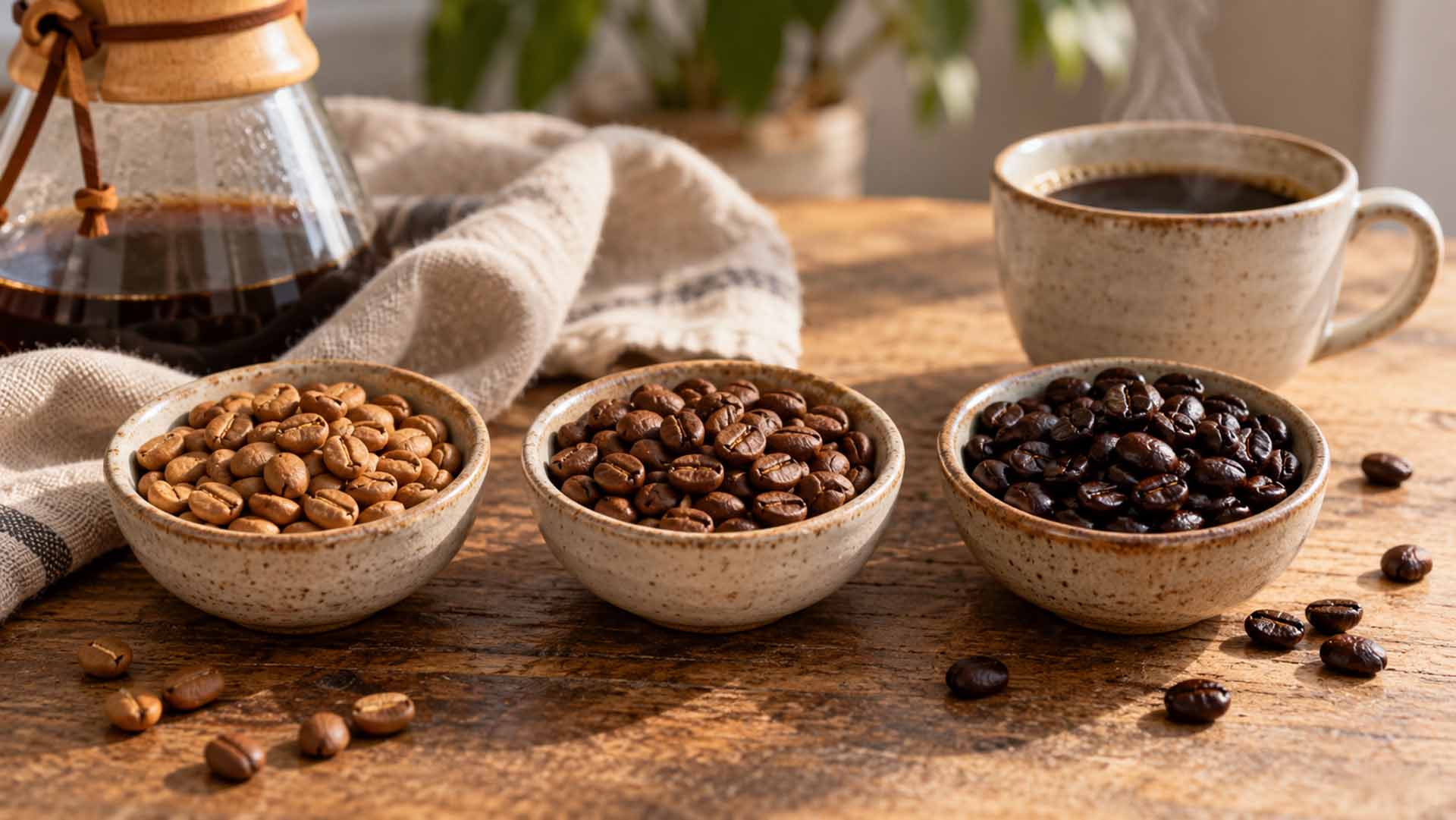
Light. Medium. Dark.
They’re familiar labels on coffee bags, but they don’t tell the whole story.
Roast level can influence sweetness, acidity, body, aroma, and the balance between the flavors naturally present in a coffee and those developed during roasting. But roast level isn’t a measure of quality, and darker doesn’t automatically mean stronger.
At Alpen Sierra, we think about roasting as flavor development.
Every coffee responds differently to heat depending on where it was grown, its variety, elevation, processing method, moisture content, density, and other characteristics. The goal isn’t simply to make a coffee light, medium, or dark.
It’s to find the roast profile that allows that particular coffee to taste its best.
Coffee begins as a green seed inside the fruit of the coffee plant. In its unroasted state, it looks, smells, and tastes very different from the coffee we recognize in the cup.
Roasting transforms it.
As heat is applied, the beans lose moisture, expand, change color, and undergo a series of chemical reactions that create hundreds of aromatic and flavor compounds.
The further a coffee progresses through that process, the more the character of the roast begins to influence what we taste.
In simple terms:
Lighter roasting tends to reveal more of the coffee itself.
Medium roasting balances origin character with flavors developed during roasting.
Darker roasting brings roast-developed flavors further forward.
That sounds straightforward, but good roasting involves considerably more nuance.
At Alpen Sierra, we roast on a Loring Smart Roast system, which gives us precise control over heat and airflow while allowing us to develop and repeat individual profiles for different coffees.
Technology helps us control the roast. Experience tells us where we want to take it.
You can learn more about that process on our Coffee Roasting Process page.
Light roasting leaves more room for the characteristics of the green coffee to remain front and center.
Depending on the coffee, you might encounter flavors reminiscent of:
Light roasts also tend to have more noticeable acidity and a lighter body.
The word acidity sometimes gets a bad reputation in coffee, but good acidity doesn’t mean unpleasantly sour.
Think about the brightness of an apple, the crispness of citrus, or the lively character of certain wines. In coffee, acidity can create that same sense of freshness and structure.
This is one reason exceptional single-origin and microlot coffees are often roasted on the lighter side. When a coffee has distinctive characteristics related to variety, terroir, or processing, lighter roast development allows more of those qualities to remain visible in the cup.
If you enjoy exploring those distinctions, browse Alpen Sierra’s current Microlot Reserve and single-origin coffees.
Light roast may appeal to you if you enjoy coffee that is:
It can also be a great choice if you enjoy comparing coffees from different growing regions.
A naturally processed African coffee might offer ripe fruit and floral notes, while a washed Central American coffee roasted to a similar level could present citrus, chocolate, or honey.
The roast leaves enough room for those differences to show.
That doesn’t make light roast better or more sophisticated.
It simply puts the emphasis on a different part of the coffee.
Medium roast begins to bring the flavors of origin and roasting together.
Many of the coffee’s natural characteristics remain present, but additional roast development can create more sweetness, body, and depth.
Common flavor impressions might include:
Acidity often becomes softer than in a light roast, while the mouthfeel becomes rounder.
For many coffee drinkers, this is the sweet spot.
A good medium roast can offer enough brightness to keep the cup lively while introducing the chocolate, caramel, and toasted flavors people often associate with a comforting cup of coffee.
Medium roast is a good place to explore if you prefer:
It can also be an approachable introduction to specialty coffee because it bridges familiar coffee flavors with more distinctive characteristics from origin and processing.
If you’re beginning to explore the larger world of specialty coffee, our article Specialty Coffee Explained: What Makes a Premium Roast Worth It offers a useful next step.
This is where the standard light-medium-dark conversation becomes a little too simple.
At Alpen Sierra, Full-City is an important part of the roast spectrum.
We think of Full-City as a place where the coffee’s individual character is still evident, but additional roast development creates more caramelization, richness, and body.
You might encounter notes reminiscent of:
For someone who enjoys a richer cup but doesn’t necessarily want the deeper roast character associated with dark coffee, Full-City can be an excellent middle ground.
It’s also a good reminder that roast levels aren’t perfectly defined boxes.
There are plenty of worthwhile stops between them.
You can explore Alpen Sierra’s current coffee selection to compare Full-City offerings with lighter and darker roast profiles.
As coffee is roasted darker, the flavors created during the roasting process become increasingly prominent.
Dark-roasted coffees may bring forward characteristics such as:
Perceived acidity generally becomes lower, while roast intensity and body become more noticeable.
You may also see oils begin to appear on the surface of darker beans as roast development changes the structure of the coffee.
For people who enjoy a bold, rich, traditional coffee profile, dark roast can be deeply satisfying.
But there’s an important distinction.
Dark doesn’t have to mean burnt.
A well-developed dark roast should still have sweetness, aroma, structure, and character. The goal isn’t to roast every distinctive quality out of the coffee.
It’s to develop deeper flavors without losing balance.
For an even deeper dive into that roast style, see our article Dark Roast Coffee.
Dark roast may be right up your alley if you enjoy:
There’s no need to graduate from dark roast to something lighter.
If dark coffee is what you enjoy, that’s your coffee.
A roast profile that works beautifully for one coffee may not work nearly as well for another.
That’s because green coffees aren’t interchangeable.
Growing elevation affects density.
Processing affects flavor and physical characteristics.
Variety matters.
Moisture matters.
Bean size matters.
Origin matters.
At Alpen Sierra, we take those characteristics into account when developing a roast profile rather than forcing every coffee through the same formula.
The idea is fairly simple:
Roast for the coffee in front of you.
The more interesting part is figuring out exactly what that coffee wants to become.
That combination of control, tasting, adjustment, and repetition is where the craft of roasting lives.
Our Coffee Roasting Process explains more about how variety, growing altitude, processing, moisture, heat application, and roast-profile control come together at Alpen Sierra.
This is one of coffee’s most persistent myths.
Dark roast often tastes stronger, so it’s easy to assume it also contains significantly more caffeine.
Not necessarily.
Caffeine remains relatively stable during normal coffee roasting. What changes considerably is the bean itself.
Coffee loses moisture and mass as it roasts. Darker beans generally become less dense than lighter ones.
That means the way you measure your coffee matters.
If you compare coffee by scoops, you may not actually be comparing the same amount of coffee by weight.
Measured by weight, the difference in caffeine between roast levels is generally much less dramatic than many people expect.
If caffeine is what you’re concerned about, the amount of coffee used and the brewing method often matter more than whether the beans look light or dark.
Our article How Much Caffeine Is in Coffee? goes deeper into that subject.
That depends entirely on what you mean by stronger.
Dark roast often has a more intense flavor because roast-developed characteristics like dark chocolate, caramelization, toast, and smoke are more prominent.
But flavor intensity isn’t the same thing as brewing strength.
You can brew a very concentrated cup of light roast or a relatively mild cup of dark roast depending on how much coffee and water you use.
That’s why roast level and coffee-to-water ratio should be thought of separately.
Roast level helps determine what flavors are emphasized.
Your brewing ratio helps determine how concentrated the coffee is in the cup.
For a practical starting point, see our Coffee-to-Water Ratio: The Complete Brewing Guide.
Generally speaking, perceived acidity becomes less prominent as roast development increases.
Light roast tends to show more brightness.
Medium roast softens some of that acidity.
Full-City brings more richness and caramelization.
Dark roast typically puts acidity further into the background.
But roast level is only one part of the equation.
Origin, processing, grind size, water quality, brewing temperature, and extraction all affect how acidity tastes.
A well-brewed light roast can be bright and sweet.
A poorly brewed one can taste sharply sour.
Likewise, a dark roast can taste smooth and rich—or harsh and bitter—depending on how it’s brewed.
Our guide to Why Grind Size and Water Quality Can Make a Big Difference explores two of the most important variables.
Dark roasting naturally develops more roast-derived bitterness, but excessive bitterness isn’t simply a dark-roast problem.
Brewing can create it too.
All can turn a potentially good cup into something harsher than it needs to be.
A properly roasted and brewed dark coffee should have richness and intensity without tasting like an ashtray.
That’s a fairly low bar, perhaps, but an important one.
Pour-over brewing is particularly good at revealing detail.
For that reason, we often enjoy light and medium-roasted coffees through methods such as the Hario V-Cone.
Paper filtration and controlled pouring can help highlight:
That makes pour-over particularly rewarding when you’re brewing an expressive single-origin or microlot.
But there’s no rule saying you can’t make dark roast in a pour-over.
Try it.
Coffee has a way of making rigid brewing rules feel unnecessary once something tastes good.
You can find Alpen Sierra’s pour-over technique and other brewing recommendations in our Brewing Methods guide.
Medium and Full-City coffees are especially versatile in automatic drip brewers.
They tend to deliver a comfortable balance of sweetness, body, and acidity while still allowing some of the coffee’s individual character to come through.
Dark roast also works beautifully if you prefer a deeper, more traditional cup.
One thing matters regardless of roast level: your brewer needs to get the water hot enough.
We generally look for brewing temperatures around 195–202°F.
Good coffee can’t do much with lukewarm water.
French press naturally creates a fuller-bodied cup because the metal filter allows more oils and fine particles into the finished coffee.
That texture pairs particularly well with:
Chocolate, caramel, spice, toasted nuts, and deeper sweetness tend to sit comfortably in a French press.
Still, don’t overlook light roast.
Brewing a bright single-origin coffee in a French press can produce a surprisingly expressive cup with considerably more texture than you’d get from paper filtration.
Espresso and dark roast have been paired for so long that “espresso roast” is sometimes treated as another term for dark coffee.
It isn’t.
Medium, Full-City, and dark roasts are popular for espresso because they can deliver the body, chocolate, caramel, and lower acidity associated with a traditional shot.
Lighter coffees can produce an entirely different experience.
Fruit.
Florals.
Bright acidity.
Origin character.
A lighter espresso might be exciting as a straight shot, while a deeper roast may provide the weight and richness you want in a cappuccino or latte.
Neither is automatically more correct.
The question is what you want your espresso to taste like.
Roast level is useful, but flavor preference is often an easier way to shop.
Look toward light and medium/light roasts.
Think citrus, fruit, florals, honey, tea-like character, and clearly defined origin notes.
Explore medium and Full-City roasts.
Think caramel, chocolate, nuts, brown sugar, rounded fruit, and more body.
Head toward dark roast.
Think dark chocolate, cocoa, molasses, toasted flavors, baking spice, fuller body, and less prominent acidity.
These aren’t rigid boundaries.
Coffee is far too variable for that.
They’re simply useful starting points.
You can explore Alpen Sierra’s current coffee selection across Microlot Reserve, medium/light, Full-City, dark roast, and signature blends to see how roast development plays out across different coffees.
Reading about roast level is helpful.
Putting two coffees next to each other is better.
Brew a lighter coffee and a darker one using the same method.
Taste them while they’re hot.
Then leave a little in each cup and come back as they cool.
You may notice the lighter coffee revealing more fruit or acidity.
The darker coffee may feel heavier, sweeter, or more roast-forward.
Don’t worry about identifying every tasting note on the bag.
Start with simpler questions.
Which smells sweeter?
Which feels heavier?
Which is brighter?
Which tastes more chocolate-forward?
Which finish stays with you?
And the most important one:
Which cup do you want another sip of?
That’s your palate doing exactly what it’s supposed to do.
Coffee culture occasionally turns roast preference into a hierarchy.
Light roast is sophisticated.
Dark roast is old-fashioned.
Medium roast is safe.
We don’t find any of that particularly useful.
The job of a roaster is to develop flavor.
The job of the coffee drinker is to enjoy the result.
Sometimes that might be an expressive microlot with bright fruit and floral notes.
Other mornings call for a deep, rich cup before heading into the mountains.
Both can be excellent coffee.
After all, the point isn’t to drink the roast someone else thinks you should like.
It’s to find the coffee that makes you look forward to the next cup.
Light, medium, Full-City, and dark roast are different expressions of coffee—not different grades of it.
Light roasting tends to leave more of a coffee’s origin and processing characteristics exposed.
Medium roasting brings those qualities together with additional sweetness and roast development.
Full-City adds richness and caramelization while keeping plenty of the coffee’s personality intact.
Dark roasting moves deeper roast flavors, body, and intensity toward the foreground.
The interesting part isn’t deciding which one wins.
It’s tasting what changes.
Try different origins. Try different roast profiles. Brew the same coffee more than one way.
You may confirm that the roast you’ve always loved is exactly where you want to stay.
Or you may find something you weren’t looking for.
Either way, pour another cup.
Dark roast often tastes stronger because roast-developed flavors are more pronounced. But roast level alone does not determine the strength or concentration of brewed coffee.
Light, medium, and dark roasted coffees contain relatively similar amounts of caffeine when compared by weight. Dose and brewing method often have a greater effect on the caffeine in your finished cup.
Light roast generally has more noticeable perceived acidity and brightness. As roast development increases, that acidity tends to become less prominent.
Full-City is a roast development level between lighter profiles and darker roasting. It allows much of the coffee’s origin character to remain evident while introducing additional caramelization, richness, and body.
Dark roasting can produce more roast-derived bitterness, but harsh bitterness can also come from brewing variables such as an overly fine grind, too much extraction, or prolonged heat after brewing.
Medium or Full-City can be excellent starting points because they combine familiar chocolate, caramel, and nutty flavors with enough origin character to demonstrate what makes different coffees distinctive.
Medium roast may taste fuller or more roast-developed, but it doesn’t necessarily contain more caffeine or produce a more concentrated cup.
Any roast can be enjoyed black. Light roast emphasizes brightness and origin character, medium and Full-City offer balance and sweetness, and dark roast emphasizes body and deeper roasted flavors.
One key factor that is often overlooked is aftertaste. Pay attention to how the coffee finishes and what flavors remain after the sip, as that can tell you a great deal about the quality and balance of the roast.
The best choice ultimately depends on what you enjoy.